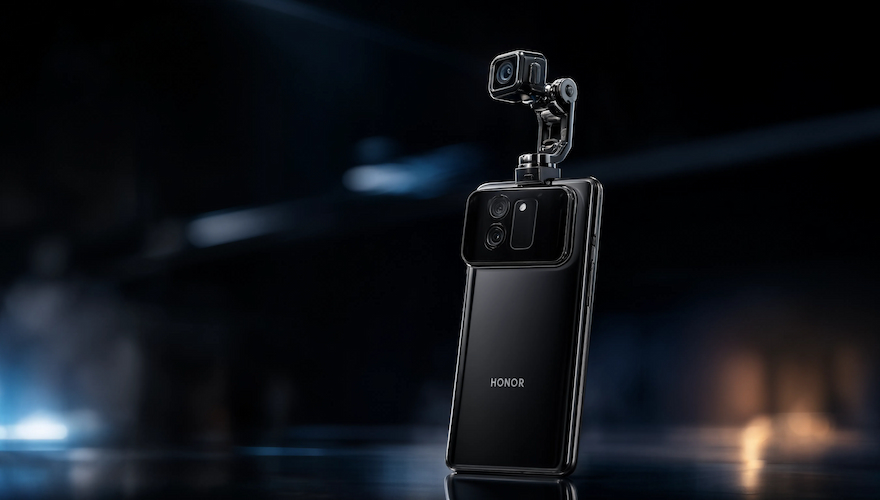
The Honor robot phone is a phone with a gimbal. That sentence sounds strange at first. But Honor built it anyway. And they didn’t stop at a prototype. They mass-produced it. They sold it to real customers. The Robot Phone marks a bold move for Honor. The brand didn’t just add a gimmick. They rebuilt their entire identity around this device. Honor calls it a new kind of smartphone. They believe it changes how people interact with their phones. This review digs into whether that claim holds up.
Honor Robot Phone First Impressions: A Big Box With a Big Surprise
The unboxing sets the tone immediately. The box is huge. The phone sits right on top. Cables and chargers fill the space underneath. But one item stands out: a strange-looking cover. More on that later. Using the phone feels unusual from the start. Slide the protective cover open. Tap the button below the camera app. Then watch the gimbal pop out in a wild, almost theatrical animation. It’s fully calibrated the moment it appears. Nothing else on the market looks quite like this.
Stability That Actually Impresses
The stabilization blew expectations out of the water. A side-by-side shake test against a leading iPhone told the whole story. The iPhone’s footage looked like it survived an earthquake. The robot phone stayed smooth. It corrected both vertical and horizontal shake. The result looked almost too steady to be real.
This isn’t a small feat, either. The gimbal runs on the industry’s smallest micromotor. It’s 70% smaller than a typical gimbal motor. Yet the phone still delivers a bright screen, a flagship chip, a large battery, fast charging, and generous storage. On paper, this device reads like a technical benchmark. One flaw stands out early on, though. The default color science looks a bit off. Skin tones in particular come across strange straight out of the camera.
Taking Control: Manual Gimbal Modes
The second layer of this phone hands control to the user. A joystick lets you drag the camera in any direction. A response setting adjusts how fast or slow the gimbal reacts.
Cinematic modes add even more range. Choose a 90-degree option, and the gimbal spins the shot cleanly to one side. Tap again, and it swings the other way. Choose 180 degrees, and the camera tilts straight up toward the sky, then rotates slowly all the way around. It practically begs to film a starry night.
Other modes round out the toolkit:
Tilt lock keeps the horizon level, no matter how the phone twists.
FPV mode locks the gimbal facing forward.
Vertical FPV locks it facing down.
Super Steady Mode blends several tricks for outstanding results.
The stabilization in these modes beats most dedicated smartphone gimbals on the market. That makes sense, honestly. This gimbal lives inside the phone. It doesn’t need Bluetooth or a cable to sync. It reacts faster because of it. And since it’s built in, there’s nothing extra to charge. Bring the phone, and the gimbal comes with it.
Honor Robot Phone Smart Tracking: When the Camera Follows You

The third level takes control away from the user entirely. Tap a subject twice, and the camera tracks it automatically. Move a can of soda around, and the gimbal chases it with surprising speed. The tracking isn’t flawless, though. It stumbles from time to time, especially with unpredictable movement. Confidence builds with use, but the system isn’t perfect yet. The tracking range impresses regardless. The gimbal covers 310 degrees. It swings almost the entire way from the rear view to the front view in one continuous shot. That means the same camera serves as both the rear and front lens.
READ ALSO: Alienware 18 Area-51: The Most Expensive Gaming Laptop
The Alienware 18 Area-51 commands attention instantly with its signature Legend industrial design language. Crafted with a premium anodized aluminum chassis, it balances ultra-durable protection with a clean, futuristic aesthetic. Smooth chamfered edges, dark metallic finishes, and clean lines accentuate its aggressive silhouette.
The Camera Hardware Behind the Magic
The sensor backs up the hype. The main gimbal camera packs 200 megapixels, an f/1.6 aperture, and a large 1/1.28-inch sensor. That spec sheet rivals the best rear cameras on the market today. The rest of the camera array holds its own too:
A 50-megapixel front camera
A 50-megapixel ultra-wide camera
A 200-megapixel telephoto camera
Most buyers will likely treat these as backups. The gimbal camera does almost everything on its own, including video calls. Walking and talking while the gimbal follows your face feels completely natural. One weakness shows up here, though. The tracking loses its subject easily if you look away.
Honor Robot Phone: A New Way to Shoot Panoramas
The moving camera opens up creative tricks beyond stabilization. Panoramas, for instance, no longer need manual sweeping. Tap a button, and the phone captures four photos on its own. It stitches them together instantly. Group selfies get a boost too. The gimbal camera captures a wider range than most front cameras allow. A “mega wide” mode goes even further. It captures nine photos across a full grid and merges them into one image. The final field of view beats even an ultra-wide lens.
A magnetic phone holder ships in the box to support all this movement. It acts almost like a two-stage stabilizer, keeping the phone upright while the gimbal spins.
Sadly, the execution falls short in one key area. The mega-wide photo, stitched from nine 200-megapixel shots, outputs at just 24 megapixels. That’s a missed opportunity. The hardware clearly supports much higher resolution. The stitching itself isn’t flawless either. Other phones without any of this tech produce cleaner blends.
Honor Robot Phone: A Full Cinema Camera Experience
Honor didn’t stop at stabilization tricks. They built an entirely new cinema camera app for this device. It includes:
Log recording for professional color grading later
The ARRI camera looks, added with a single tap.
False color mode to spot overexposed areas.
Focus peaking to confirm sharp focus.
Golden ratio guides help frame subjects.
The ARRI looks like it will help fix that earlier color complaint. Footage feels far more premium once applied.
Honor Robot Phone AI Assistant: Embodied AI
Things get unusual again with the built-in AI assistant. A palm gesture wakes it up. Turn your hand over, and the assistant responds. The gesture detection works reliably, even without perfect technique. Honor calls this combination “embodied AI.” It blends smartphone controls, an AI chatbot, and live video streaming into one experience.
The party tricks are fun but limited. Ask it to spin around and take a photo, and it takes so long that the moment often passes. Instruct it to dance, and the gimbal wiggles to the beat, with mixed results. Ask who should pay the bill, and it scans faces in the room and picks someone, mostly for laughs.
Live chat shows a bit more promise. The assistant can comment on an outfit or answer casual questions. But similar features already exist without a moving camera. Gemini handles this kind of task just as well, sometimes better. This embodied AI angle likely targets Asian markets first. Robots and playful gadgets tend to land well there. For now, though, the features feel more like decoration than daily tools.
Is the Honor Robot Phone Built to Last? Durability Questions Remain
Honor pushed the gimbal through rigorous testing before launch. It even earned IP54 water and dust resistance, a genuinely impressive achievement for a device with moving parts. Still, some concerns linger. Moving parts and precise calibration raise the stakes for durability. A hard fall could do real damage. Even a smaller bump might throw the gimbal out of alignment. Repair shops will likely struggle with a device this complex. Vertical video also reveals a limitation. The gimbal itself can’t rotate vertically. Recording vertical clips drops the resolution from 4K to 2.8K, since the phone crops the frame instead of rotating the camera.
Honor Robot Phone Final Verdict
The Honor Robot Phone earns real respect. The engineering behind it is genuinely impressive. Honor didn’t sacrifice performance elsewhere to fit the gimbal in. The screen, chip, battery, and charging all hold up as flagship-level features. Not everyone needs this level of stabilization, though. It’s a niche feature wrapped in an otherwise excellent phone. Early adopters and content creators will likely love it most. And if Honor follows through on plans to open-source the gimbal for developers, this could evolve into something far more useful down the road. For now, the Robot Phone stands as proof that phone makers still take real risks. That alone makes it worth watching.
About the Author