If you have never purchased a monitor designed for gaming or are attempting to determine if upgrading is worthwhile, you likely have numerous questions regarding ideal screen dimensions, pixel count, frame rates, extra capabilities, and similar factors. Shopping for a gaming-focused display is significantly more complex than selecting standard computer screens, particularly for average buyers operating within a firm budget. That difficulty arises because you must weigh the specific genres you play alongside the performance limits of your graphics processing unit when deciding where to compromise to save money. Furthermore, with refresh speeds frequently reaching 240Hz or higher and OLED panels falling below the $500 mark, you might question whether these features truly make a difference for your setup.
Overview & Editor’s Top Recommendations
To provide a strong mix of visual quality, range of features, and overall performance, my primary preference is the LG Ultragear 32GS95UE, a 32-inch 4K OLED screen equipped with nearly every feature expected in its category. It boasts dual refresh rate capabilities (delivering 240Hz at 4K resolution and 480Hz at 1080p), detailed control over display parameters, numerous color calibration tools for content creators, and impressive integrated audio. Its official retail cost sits at a hefty $1,400, which, while not unreasonable for an upper-tier display, remains steep for a device with potential hardware limitations, such as omitting DisplayPort 2.1 and lacking high-speed USB hubs or USB-C video connectivity. Because its price dropped to roughly $1,100 during major holiday sales, patient shoppers might secure similar discounts during future promotional events.
At a price point well below $1,000, the second-generation Sony InZone M9 2 brings meaningful upgrades over its predecessor for buyers seeking a mid-tier HDR display that retains visibility in shadowy game environments. These top display selections draw directly from objective benchmark testing alongside hands-on gameplay evaluation. Because testing remains ongoing as new models launch, these recommendations will undergo periodic updates.
Detailed Reviews
LG Ultragear 32GS95UE — Top Pick Overall
Expert Summary: Despite its premium price tag, the 4K OLED Ultragear 32GS95UE offers a well-rounded combination of design, feature set, and visual output. It delivers remarkable picture quality, inheriting standard OLED strengths like true black levels for high contrast, complete coverage of the P3 color space, high color fidelity, and rapid pixel response times. LG equips the panel with extensive capabilities, including a dual-mode 240Hz/480Hz refresh rate (with 480Hz restricted to 1080p resolution), customizable onboard color profiles managed via LG software and optional hardware calibrators, and exceptionally granular control menus. Additionally, the screen features robust built-in under-bezel speakers that far surpass typical monitor audio output. These speakers produce enough volume for casual gaming, music listening, and video playback without needing extra desktop hardware, though audio clarity decreases when listening from off-center angles.
Absence of DisplayPot 2.1
While it takes top honors for its overall balance, it is far from perfect. Notable flaws for a monitor in this price bracket include the absence of DisplayPort 2.1, the lack of USB-C video or power delivery options, and text-rendering artifacts that could deter certain users. The included stand is functional and stable, yet its construction relies heavily on standard plastic materials. Out-of-the-box color accuracy tests yielded respectable but non-professional results, requiring further calibration for color-critical production work.
Default baseline settings show a white point near 6300K, a 2.2–2.3 gamma curve, and standard SDR brightness around 265 nits (capable of peaking at 400 nits). Color variance averages under 3 Delta E 2000, which custom calibration can further refine. HDR highlights peak around 650 nits across a 10% window using the low peak brightness setting (which provides optimal tone mapping), though pushing settings to extreme limits can push 1% window highlights past 1200 nits at the expense of image quality. Given its $1,400 list price, waiting for sale prices near $1,100 provides a far better value proposition.
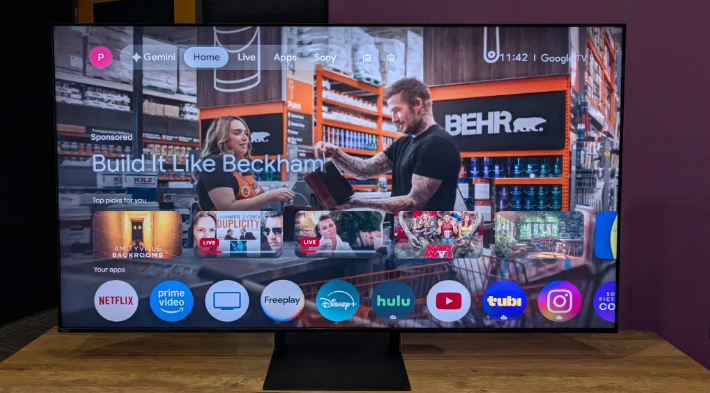
Sony InZone M9 2 — Best HDR Display Under $1,000
Expert Summary: While the original InZone M9 offered good foundation features, its overall usability suffered from frustrating design choices. For the second-generation model, Sony resolved key shortcomings on this 27-inch IPS panel by incorporating a more practical stand, a dedicated 24.5-inch display mode, improved factory presets, and a slight refresh rate boost to 160Hz. The revised stand replaces the oversized footprint of its predecessor with a compact, flat base that frees up desk space while supporting full swivel and pivot adjustments. Rather than pivoting solely at the neck, the base features an integrated turntable mechanism that enables full left-to-right rotation.
A simple silicone cable loop provides a clean, flexible solution for managing wires when adjusting monitor height or angle. Certified for DisplayHDR 600, the M9 2 serves as a strong choice for affordable HDR gaming. While OLED panels achieve deeper blacks by turning off pixels completely, they occasionally crush shadow details; remapping bright highlights is visually preferable to boosting dark shadow gain, which introduces visual noise. Preserving shadow detail is often far more critical in games than expanding extreme highlight brightness. In HDR mode, the panel achieves 96% P3 color space coverage, a 6300K white point, and 795 nits peak brightness in a 10% window, alongside preset modes tailored for games and cinema. Full-array local dimming enhances contrast significantly, allowing black levels to drop down to 0.017 nits.
SDR
SDR default mode trends slightly cool (around 7400K with local dimming disabled) while reaching 400 nits full-screen brightness with a 2.2 gamma curve. The sRGB picture profile provides strong color precision, recording an average Delta E of 1.11, 99% gamut coverage, 2.2 gamma, and a 6200K white point. The primary drawback is Sony’s removal of the USB-C port featured on the original model. Motion handling exhibits minor blur, and the included backlight scanning feature tends to introduce halo artifacts rather than fully clarifying motion. While its $800 retail price is slightly high for its feature set, promotional discounts bringing it down toward $650 to $700 make it a much more compelling purchase.
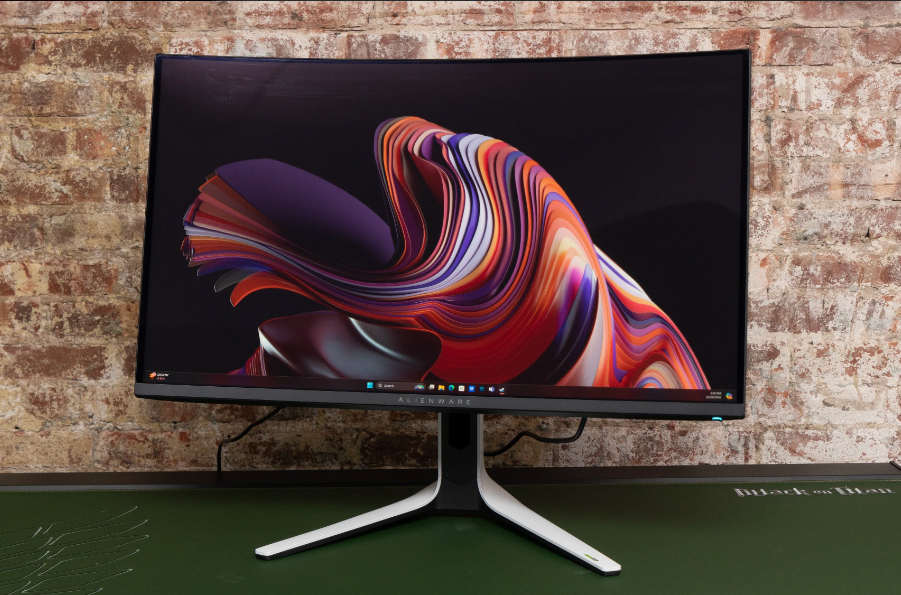
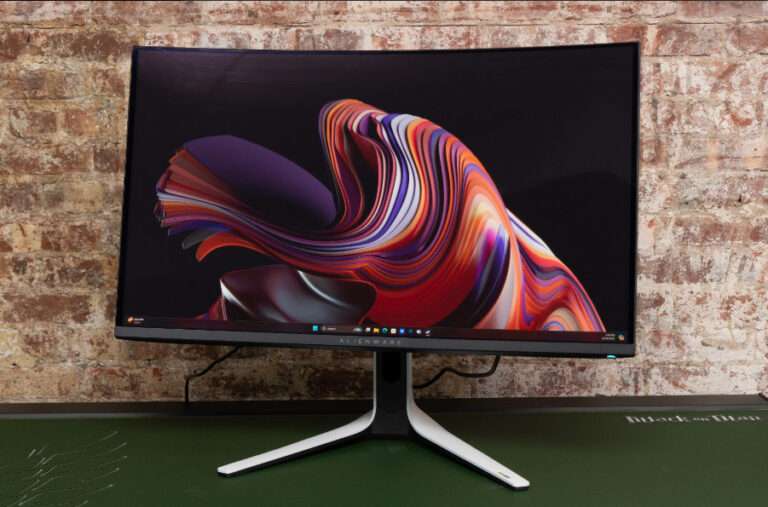
Alienware AW3225QF — Best Matte/Non-Reflective QD-OLED
Expert Summary: Standard OLED panels usually employ glossy screen finishes that enhance color vibrancy, but users working near windows or strong light sources will benefit significantly from an anti-reflective matte coating. The Alienware AW3225QF provides effective anti-glare treatment, which is particularly beneficial given its subtle panel curvature that can otherwise catch side reflections. Beyond glare reduction, the display includes practical additions like heat-dissipation vents along the rear housing and a height-indicator scale built into the stand. Cable management remains somewhat awkward, requiring wires to be routed through a tight opening in the lower stand base.
It offers broad preset support for SDR, HDR, Dolby Vision, and pre-calibrated DCI-P3 and sRGB color profiles. Standard default parameters trend slightly dim (170 nits) and warm (6000K), but all values are fully adjustable. Smart HDR mode maps HDR signals into the operating system’s standard color space by default, though automated setting adjustments can be disabled manually. Using Peak 1000 HDR mode yields 1000 nits brightness in a 2% window, whereas standard HDR reaches roughly 450 nits in a 10% window. At its $1,200 retail price point, the lack of DisplayPort 2.1 and full USB-C video input is notable, making sale prices near $900 much more attractive.
Lenovo Legion R25f-30 — Best Budget Option
Expert Summary: Shopping on a tight budget requires setting realistic expectations regarding performance compromises. Entry-level 25-inch displays inevitably trade off certain capabilities, which is true for the Legion R25f-30. In exchange for a fast 240Hz refresh rate (overclockable to 280Hz) and basic integrated speakers, the VA panel experiences narrow viewing angles and includes a disproportionately large stand. Despite marketing claims, its peak brightness is insufficient for true HDR playback. Given that real-world retail pricing frequently drops to $140 compared to its nominal $210 list price, it remains a solid entry-level choice for high-refresh-rate gaming on a strict budget.