The Ojibwe Natives Of Illinois Wiidigendiwin/Marriage Traditions
The Pre-Marriage Journey: Readiness and Proposal
Spiritual Guidance and Pre-Ceremonial Preparation
The Three-Day Celebration: Feasting, Visiting, and Giveaway
-
Day One: The Sacred Feast—The community gathers under a grand natural arbor or woven cedar shelter to partake in traditional foods, including wild rice, venison, squash, beans, and fresh berries. Elder sponsors bless the bountiful spread before anyone consumes the food, ensuring that all prepared nourishment is entirely shared or given away to honor the spirits.
-
Day Two: Community Visiting—The couple visits members of both extended families, listening to stories, receiving oral wisdom, and offering gratitude for their upbringing. This process reinforces the idea that marriage unites entire kinship networks rather than isolated individuals.
-
Day Three: The Giveaway Ceremony—In keeping with the fundamental Ojibwe principle of generosity, the bride and groom present hand-crafted gifts—such as beadwork, carved tools, woven baskets, and blankets—to every single guest present. Wealth in Ojibwe culture is measured not by what one accumulates, but by what one gives away.
Sacred Rituals of the Wedding Ceremony
Misconceptions, Nuance, and Cultural Realities
-
Consummation Privacy: Contrary to sensationalized myths suggesting public oversight, Ojibwe culture deeply values personal modesty and sacred privacy. Private intimate moments remain strictly between the couple once the public festivities conclude.
-
Complementary Roles: Traditional Ojibwe society views all genders as equal, complementary partners. While men historically focused on hunting, protection, and external diplomacy, women maintained the home, managed agricultural harvesting, controlled domestic assets, and held supreme authority over family governance.
-
Marital Stability and Dissolution: Marriage represented a lifelong commitment to survival and spiritual growth. However, if infidelity or severe disloyalty occurred, tribal customs permitted dissolution. In such cases, the symbolic separation of the wedding blanket marked the official end of the union, allowing individuals to seek restoration and healing.
In traditional Ojibwe wedding customs (Wiidigendiwin), the wedding blanket holds deep spiritual and social significance, symbolizing the union of two separate lives into a single shared path.
Symbolism and Ritual Use
-
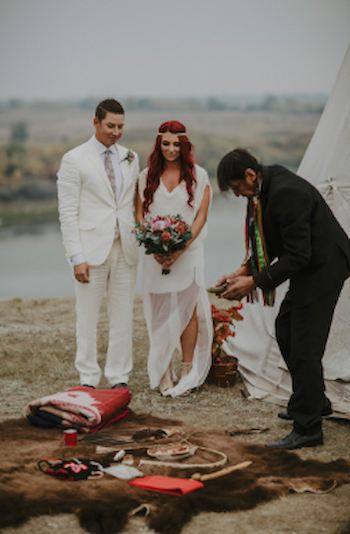
Separation of Past Lives: At the beginning of the ceremony by the sacred fire, the bride and groom each wear individual blue blankets over their shoulders. These blue blankets represent their separate pasts, individual hardships, and lives spent in solitude.
-
Casting Away the Old: As part of the ceremonial transition, the couple casts off their blue blankets, symbolically shedding their single identities, past burdens, and former lives.
-
The Unified White Blanket: Relatives or elder sponsors then gently drape a single, large white blanket over the shoulders of both the bride and groom simultaneously. Embracing beneath this shared blanket signifies their commitment to walk together in peace, warmth, mutual protection, and shared purpose.
Cultural Meaning
The white blanket represents purity, peace, and spiritual harmony under the blessings of Gichi-Manidoo (the Great Spirit). In traditional times, if a marriage ever reached an irreparable breakdown and was dissolved according to tribal custom, the ceremonial separation of this wedding blanket marked the formal end of the union.
In Anishinaabemowin, traditional Ojibwe wedding blessings are spoken by elders, clan leaders, or pipe carriers to invoke Gichi-Manidoo (the Great Spirit), the four directions, and the sacred natural elements to bring balance, endurance, and love to the marriage.
Traditional Ojibwe Wedding Blessing Words
“Gichi-Manidoo, miigwech giinawind dash bi-wiidookawiwaang. Great Spirit, we thank you for coming to guide and help us.
Gwayakowaadiziwin gi-da-ganawendaamin zhawenimidiwin-ina. We honor upright living and deep, unconditional love.
Mino-bimaadiziwin: Bisaanisin, mashkawizin, miinawaa zhawenimiwewin. May you walk the good path of life: with peace, strength, and kindness.
Niiwin wendanimagag: Giizhig, Aki, Nibi, Ishkode—gi-da-zaagi’igoom. From the four directions: Sky, Earth, Water, and Fire—may all creation love and protect you.
Apeing gi-da-miigwechiwendam ji-wiidoopamediwaeg gaye ji-aawiyaeg bezhig bimaadiziwin. May you always give thanks as you eat together and live as one shared life.”
Core Cultural Concepts in the Blessing
-
Mino-bimaadiziwin (The Good Life): The central Ojibwe philosophy wishing the couple a harmonious, honorable, and healthy life grounded in spiritual balance.
-
The Four Directions and Sacred Elements: Prayers call upon the powers of the North (endurance), East (new beginnings), South (growth), and West (wisdom), alongside Earth, Water, Fire, and Sky.
-
Interconnected Community: The blessing reinforces that the couple’s bond extends outward to embrace their families, clans, future generations, and reverence for Mother Earth.
About the Author

Synonymous
Administrator
I just adore opening up through writing. I am an open book in a culture that never reads.