The Sacred Bonds of Onʌyote’aːka: Unveiling the Marriage Traditions of the Oneida Nation
Deep within the ancestral heritage of the Haudenosaunee Confederacy, the Oneida Nation—known in their native tongue as Onʌyote’aːka or “People of the Standing Stone”—holds a rich, sacred tradition surrounding marriage. Far more than a mere contract between two individuals, traditional Oneida marriage represents a profound alliance that unifies clans, balances spiritual duties, and anchors the community in the enduring wisdom of a matrilineal culture.
Matrilineal Society and the Authority of Clan Mothers
To understand Oneida marriage, one must first appreciate the central pillar of Oneida governance: matrilineality. In Oneida society, lineage, family identity, and property rights pass directly through the mother’s line. Every member of the nation belongs to one of three primary clans: the Turtle, the Bear, or the Wolf.
Clan mothers, revered female elders who hold supreme authority within the social order, historically guided matchmaking and marital arrangements. When two young people demonstrated readiness for marriage, the Clan Mothers evaluated the match to ensure harmony, political balance, and social cohesion across families. A man did not simply ask for a woman’s hand; his mother and Clan Mother engaged in thoughtful discussions with the woman’s Clan Mother to gain formal approval.
Strict Exogamy: The Clan Law of Marriage
Oneida custom enforces strict clan exogamy. Because every member of the Bear Clan considers all other Bear Clan members as brothers and sisters, individuals must marry outside their own clan. A Turtle Clan member, for instance, must choose a partner from the Bear or Wolf Clan.
This mandatory inter-clan marriage system plays a crucial political and societal role. By interweaving families across clans, the Oneida people built an interconnected community where personal conflicts were minimized, and widespread unity was sustained across the entire confederacy.
Courtship, Reciprocal Gifts, and Skill Demonstrations
Traditional Oneida courtship relied on tangible demonstrations of responsibility, skill, and mutual care rather than romantic sentiment alone. A young suitor proved his ability to sustain a home through hunting and fishing prowess, while a young woman demonstrated her capacity to nourish a family through agricultural skill and domestic craftsmanship.
The formal agreement between families unfolded through symbolic gift exchanges:
-
The Suitor’s Offering: The prospective groom presented freshly hunted game—such as venison or bear meat—to the bride’s mother, proving his commitment and physical capability as a provider.
-
The Bride’s Reciprocation: If the bride and her family accepted the suitor, the bride presented the man with hand-crafted corn cakes or cooked corn dishes, showcasing her mastery of agriculture and culinary preparation.
Sharing this ceremonial food signaled mutual acceptance and formal agreement between both families.
READ ALSO: The Ojibwe Natives Of Illinois Wiidigendiwin/Marriage Traditions
Long before a wedding ceremony takes place, Ojibwe society establishes strict readiness milestones grounded in spiritual growth and maturity. A young man earns eligibility for marriage only after successfully completing his vision quest—a rigorous four-day solitary journey of fasting, prayer, and deep contemplation in nature to discover his guardian spirit and life purpose.
Matrilocal Residence: Moving into the Longhouse
Perhaps the most striking cultural distinction of traditional Oneida marriage is its matrilocal living structure. Upon marriage, the groom packed his personal belongings, left his mother’s dwelling, and moved directly into the extended family longhouse of his new wife.
The longhouse served as the center of daily social and spiritual life. Up to seventy feet long and housing multiple families of the same maternal clan, these bark-covered structures contained shared hearths and cooking fires. By entering his wife’s longhouse, the husband stepped into an established household governed by his mother-in-law and the Clan Mothers, ensuring that women retained permanent ownership of the home, land, and domestic resources.
The Wedding Ritual: Gratitude, Vows, and Sacred Food
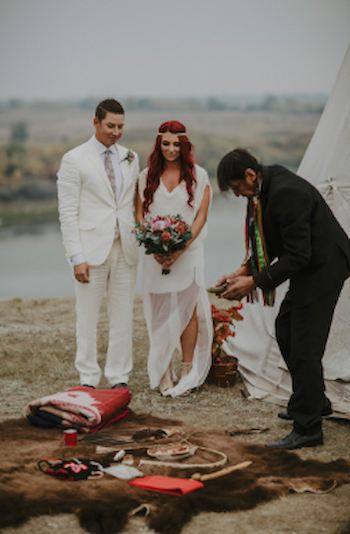
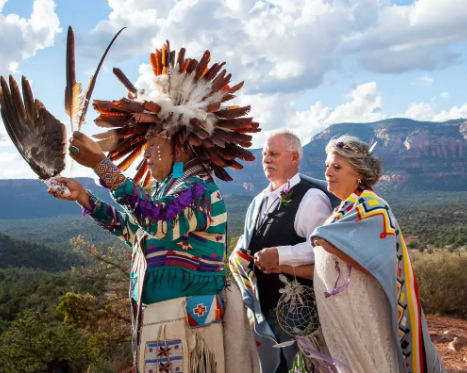
Traditional Oneida wedding ceremonies were elegant, direct, and deeply spiritual, taking place without ostentatious displays. Held in the presence of family, clan mothers, and community elders, the ceremony integrated several essential rituals:
-
Ohen:ton Karihwatehkwen (The Thanksgiving Address): Before any words of commitment were spoken, a leader or elder recited the Thanksgiving Address, giving thanks to the Creator, Mother Earth, the waters, plants, animals, winds, and stars for sustaining human life.
-
The Blessing of the Sacred Pipe: A spiritual carrier prepared a ceremonial pipe with tobacco, allowing the rising smoke to carry the couple’s promises directly up to the Creator.
-
The Exchange of Baskets and Blankets: The couple exchanged gifts of hand-woven ash-splint baskets, corn husk crafts, or hide blankets to represent their shared work and mutual comfort.
-
Sharing Corn and Fish: In a central ritual act, the couple ate from a single bowl containing traditional corn soup, bread, or fish, symbolizing their commitment to nourish one another throughout life’s journey.
Dissolution and Mutual Respect
While marriage represented a sacred and lasting bond, traditional Oneida society acknowledged that relationships could suffer breakdown. Because women maintained ownership of the longhouse, dissolution was straightforward and free of financial hardship for the wife.
If a couple agreed to separate, the husband simply gathered his personal tools, weapons, and clothing and returned to his mother’s longhouse. Children remained with the mother and her clan, fully supported by the extended family within the longhouse network.
The Legacy of Oneida Matrimonial Culture
The marriage customs of the Oneida Nation showcase a sophisticated balance of egalitarian partnership, maternal guidance, and communal harmony. Through the leadership of Clan Mothers, strict adherence to clan exogamy, and matrilocal living, Oneida wedding traditions remind us that true union strengthens the entire circle of life, family, and land.
About the Author