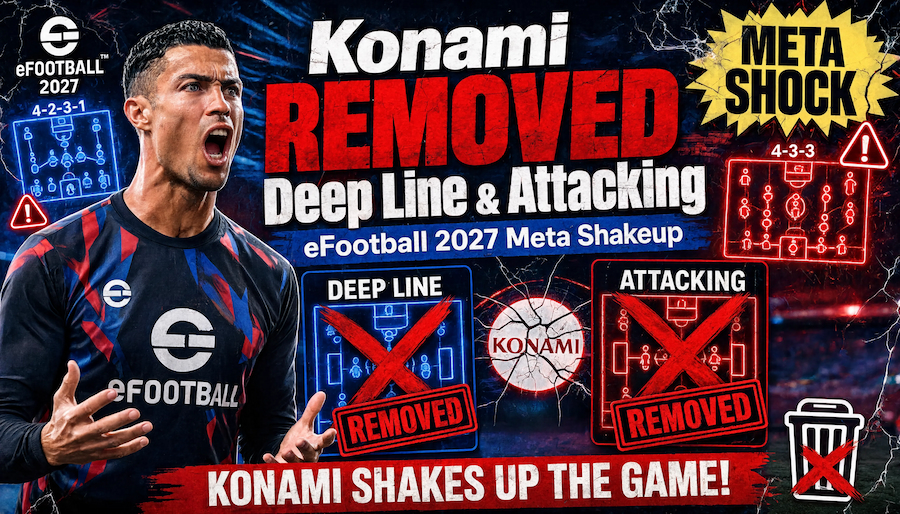
Woe to me who used to use a back three, midfield two, and a front five, giving attacking instruction to my CBs. Woe to those who used to give Rijkard deep line instruction when defending to form a back 6. And finally, woe to those who used back three formations and gave the RMF and LMF deep line instructions to form a defensive back five. Konami removed the “Deep Line” and “Attacking” individual instructions in a recent eFootball update. They wanted to overhaul tactical management. Konami replaced these manual commands with a new “Fluid Formation” option. They also reworked player behavior into explicit “attacking” and “defensive” playing styles. This change shifts the focus from manual toggles to preset tactics. Now, players follow built-in styles rather than individual instruction.
Deep Line And Attacking Removed; Did in Match Management Just get more interesting in eFootball 2027?
Yes. This fluid formation is one hell of an improvement for tactical-minded eFootball gamers. Those of us who enjoy not only scoring goals but also a good tactical management experience will find this new update absolutely satisfactory. The update aims to balance the meta and streamline instructions. Players previously exploited the “Deep Line” instruction, dropping a defensive midfielder into the backline. This created an unintentional back-five and distorted midfield balance. Removing these commands simplifies the system. It pushes players to rely on preset team structures and player proficiencies.
The new system encourages smarter tactical choices. It rewards understanding of player roles and team shape. This change also makes the game more realistic and dynamic. It forces you to think about overall strategy, not just individual tweaks. The new approach makes eFootball more competitive and tactical. It also adds depth to team management. Players must now choose formations and styles that suit their squad. This update is a bold step toward a more balanced and engaging gameplay experience. It challenges players to adapt and think strategically. The focus is now on fluid team movement and natural player behavior. This is a positive change for the eFootball community. It encourages creativity and tactical awareness. The new system brings the game closer to real football.
READ ALSO: Efootball Ranking Event Rewards 2027 Mike Maignan F2P Training Guide
Mike Maignan’s special 104-rated offensive goalkeeper card is one of the most versatile and valuable goalkeeper options available for free-to-play and competitive players alike. Featuring exceptional reflexes, high coverage reach, and top-tier jump stats, this card can anchor your defensive line effectively when built with an optimal training progression.
So what are the alternatives to Deep Line instructions in the Fluid Formation Update?

Activating the fluid formation setting in your game plan gives you an opportunity to tactically adapt to the removal of both the deep line and attacking individual instructions. You can easily achieve this by tweaking the player positioning when attacking and when defending. This, however, requires that you train your players to have multiple favorable position proficiencies.
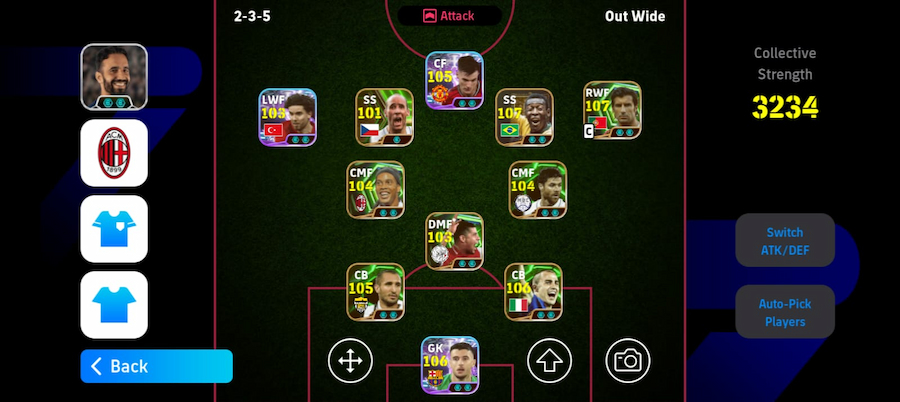
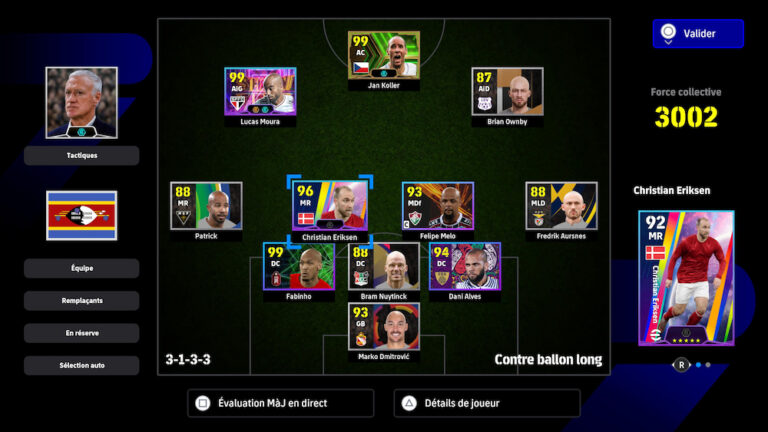
I, for example, have trained Rijkard to play as a CB in addition to his defensive midfield position. When attacking, my team plays in a 2-3-5. The two CBSs are carefully selected. 105 Chiellini for aerial dominance, attacking and defending corners. Cannavaro to track pacey opposition runs. I play Rijkard as a sole anchoring defensive midfielder due to his visionary pass playstyle and height in winning aerial balls centrally. The two central midfielders are chosen randomly based on fitness, but passing capabilities is my main selection criterion. Up the field I use 105 Sesko as my center forward, with two second strikers behind him. The second strikers are chosen based on position, ball-holding, passing, or heading abilities. Since I am an Out Wide player, I use cross specialist wingers to deliver quality crosses into the box.
Defensively
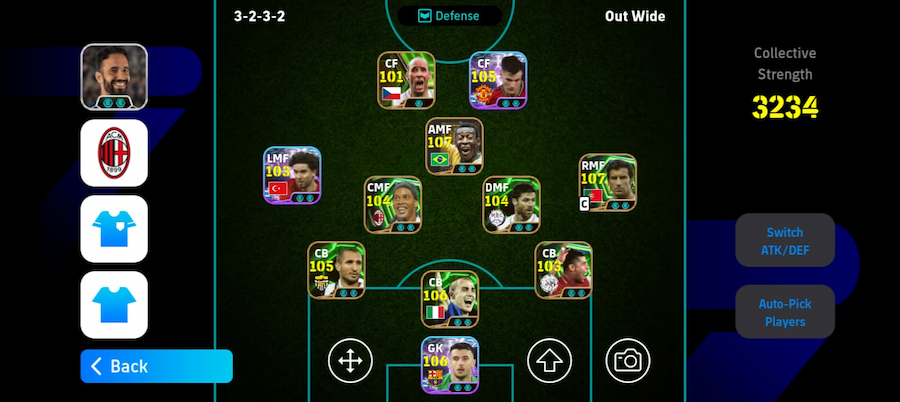
When defending, the formation morphs into a 3-2-3-2 formation with Rijkard dropping to become a central center back and Chiellini and Cannavaro defending the half spaces. The two central midfielders drop into defensive midfield and one second striker into attacking midfield. The wide players drop to lmf and rmf, respectively. The other ss and Sesko remain upfront to press and be counter targets in case I win the ball deep in my half. My defensive approach is based on having many midfielders to mark opposition players while the forwards press, forcing the opponent to play long balls to my advantage. Since defensive aerial dominance is something I enjoy, such high balls often end on the receeding hairline of Chiellini or far behind the defensive line to be cleared by my attacking goalkeeper playing sweeper.
READ ALSO: A Guide to Mastering the Overload Playstyle in eFootball 2027
The Overload playstyle in eFootball 2027 produces an attack-focused, high-energy system. In order to create short-passing triangles and numerical dominance, players gather around the ball carrier. This enables you to build attacks with smooth movement and control possession. It seems like a more advanced form of possession play. The system promotes fast, precise passes. In the final third, your team remains responsive and compact.
Deep Line And Attacking Removed; Other Strategies
One effective strategy is to use a player who acts as a DMF when your team has the ball but drops into a full-back position when you lose possession. This is the role of an inverted full-back. It adds defensive stability without sacrificing control in midfield. This setup works especially well when you want to maintain a solid defensive shape while still dominating possession.
Another smart adjustment is to turn your wingers into LMF and RMF out of possession. This gives you more defensive cover in wide areas. These players track back and support the full-backs, making your team harder to break down. Out of possession, they also help compress the pitch and limit the opponent’s space. This dual role adds balance to your tactical setup. It allows you to switch seamlessly between attack and defense. These tweaks give you better control of the game. They also make your system more adaptable to different opponents. Use these adjustments to strengthen your formation and improve your overall play. It is a simple yet effective way to get more out of your team. These changes also reflect modern tactical trends in football. They give you a competitive edge in both defense and attack.
Players Fit For This Fluid Formation
One smart tactic is to use a versatile player like Szoboszlai, who can play as a CMF in attack and drop into the right-back position when defending. This gives you extra control in midfield while maintaining defensive stability. Players with this flexibility make it easier to adapt formation without making substitutions. They also help maintain shape during transitions. This approach is especially effective when you want to dominate possession and still cover the flanks.
Many players are also trying to get the new Szoboszlai card because it offers this exact tactical flexibility. Meanwhile, some players have stopped using Trent Alexander-Arnold for various reasons. Despite his attacking quality, they prefer a more balanced option. Szoboszlai offers a unique hybrid role that many find appealing. His ability to move between CMF and RB gives managers more freedom in building their system. This makes him a valuable asset for those who want to play with tactical fluidity. His card is highly sought after for these reasons. If you want to improve your tactical options, this Szoboszlai card is a strong choice. It allows you to shift between defense and attack seamlessly.
About the Author