Every eFootball player faces the same dilemma. You have a pile of progression points, and you must decide where they go. Do you pump them into defensive stats? Or do you chase speed instead? Both choices feel right, and both choices cost you something. I dug into what the community has tested, and I found some surprising numbers. Certain stats hit a point where extra points stop helping. Other stats trigger hidden penalties when you push them the wrong way. I’ll walk you through the key thresholds and show you how to build smarter defenders.
One quick note first. Konami doesn’t publish these numbers. Everything below comes from community testing, so treat the figures as strong guidelines, not official rules.
The Core Problem with Defensive Stats
Maxed-out cards now reach astronomical ratings. Many players see a stat at 99 and think higher always means better. That belief wastes a lot of progression points. Community testing shows a different story. Past a certain point, stats hit major diminishing returns. You spend points, but the player doesn’t change on the pitch. Those wasted points could have improved a different stat that matters more.
The Thesis
Here’s my main point. Knowing key thresholds saves you points and protects your defenders from performance penalties. Two sets of numbers matter most. The first is the 90 Defensive Awareness baseline. The second is the 88 and 91 Acceleration caps. Learn these numbers, and you stop guessing.
The 90 Defensive Awareness Baseline
The Magic Number

Many players treat 90 Defensive Awareness (DA) as the crucial target. This stat controls how well the AI positions your defender. A defender with strong DA reads the play, closes passing lanes, and steps in at the right moment. Below 90, your defender makes more positioning mistakes. He drifts out of position. He reacts late. At or above 90, the AI handles most defensive situations well. That’s why the community calls 90 the baseline.
READ ALSO: Better Than Shevchenko? Breaking Down the Free 102 Nicolas Jackson eFootball Review
A free 102-rated Nicolas Jackson card recently dropped in eFootball, and the community immediately split. Some players love him. Others bench him after two matches. The debate gets louder every day. I want to share my honest take. Lowkey, this card has performed better for me than the 102 Shevchenko and the 102 Batistuta. Yes, I know. That sounds like a stretch. Stay with me, because I’ll explain why, and I’ll also show you where he falls short.
Diminishing Returns
What happens when you push DA beyond 90? Community consensus says very little changes after 95. Players rarely notice a difference on the pitch between a 95 and a 99. That fact hurts when you think about the cost. Those extra points could go elsewhere. You could improve dexterity or aerial stats instead. Those areas often change how a defender plays much more than the last few DA points.
The Acceleration and Stride Length Connection
This part surprised me most. Defensive Awareness and acceleration don’t live in separate boxes. They interact.
The Acceleration Penalty Rule
Community testers, including a user named amadeuz, reported an interesting pattern. Roughly every one-point drop in Defensive Awareness can trigger an acceleration penalty on your defender. In simple terms, lowering one stat can hurt another. This changes how you think about builds. You can’t treat each stat on its own. A defender with low DA may feel slower than his acceleration number suggests. Keep this in mind before you cut DA to boost something else.
Stride Length Thresholds
Acceleration also controls how your defender runs. Two numbers matter here.
88 Acceleration acts as the minimum threshold. At this level, the defender unlocks new running animations. He also gains a longer stride. Below 88, he keeps the shorter, slower stride.
91 Acceleration acts as the maximum benefit point. Past 91, you hit greatly diminished returns. The defender doesn’t gain much more speed in matches. You waste points if you keep going.
So the sweet spot sits between 88 and 91. Aim for that range, and you get the best result for the fewest points.
Playstyle Nuances
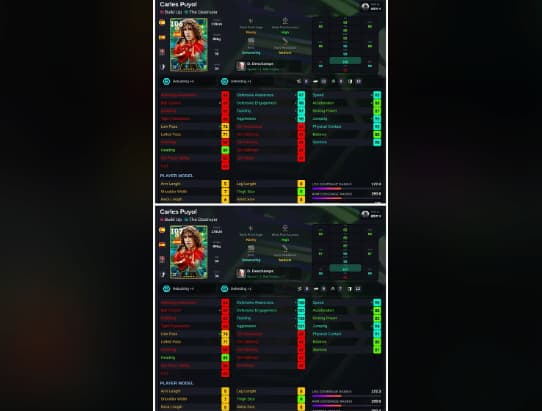
Not every defender needs the same investment. Playstyle changes the plan. Aggressive, destroyer types benefit heavily from extra acceleration. Think of a player like Puyol. He charges forward, wins the ball, and chases attackers. He needs the speed to close gaps fast. For him, those acceleration points pay off.
Covering and build-up types follow a different path. They stay behind the play and read it. Prioritize pure defensive awareness. They use positioning to stop attacks, so they don’t need the same burst of speed. Ask yourself one question before you spend points: how does this defender actually defend? His style should guide your choice.
Practical Defensive Stats Application: A Center-Back Build Case Study
Let me turn these ideas into a real plan. Imagine you build a center-back.
Balancing the Stats
Start with Defensive Awareness. Push it to around 90. Stop there unless you have spare points at the end. That gives your defender solid AI positioning. Next, check acceleration. Aim for 88 if your defender plays aggressively. If points allow, go up to 91. Don’t go beyond that.
Then look at your other stats. Spend points on these areas:
- Dexterity: This helps your defender turn, recover, and react.
- Lower Body Strength: This helps him win shoulder-to-shoulder duels.
- Aerial: This helps him win headers against tall strikers.
- Defending skills: Put the remaining points here based on the player’s role.
This balanced approach beats the “max everything” approach. You build a defender who performs well in every situation.
Defensive Stats Synergy With Partners
A defender doesn’t play alone. His partner matters too. Say you pair your custom build with a player like Kompany. Kompany brings strong positioning and leadership. Your defender can then take the more aggressive role. Your tactics also matter. In Possession Play Style, your defenders stay higher and pass out from the back. A covering defender with great awareness fits that setup. In Quick Counter, your defenders face more open space. An aggressive defender with good acceleration fits better there. Match your build to your tactics. The best defender on paper isn’t always the best defender for your team.
Common Mistakes to Avoid with Defensive Stats
Many players repeat the same mistakes. Watch out for these:
- Maxing DA to 99. You waste points that could improve other stats.
- Ignoring acceleration. A slow defender loses races against fast strikers.
- Cutting DA too low. You risk the hidden acceleration penalty.
- Copying someone else’s build. Their player ID and playstyle may differ from yours.
Avoid these errors, and your defenders will improve right away.
Final Takeaway
Don’t chase maxed-out 99-plus stats blindly. The numbers on the card don’t always match the performance on the pitch. Thresholds like 90 Defensive Awareness and 88 to 91 Acceleration give you a smarter target. They help you save points and dodge hidden penalties. Remember one more thing. Build each player around his own player ID and your team’s playstyle. A raw numerical ceiling doesn’t tell you how a player feels in a match. Testing does.
So test your builds. Play a few matches, watch your defenders, and adjust. Then share what you find. Did the 88 to 91 acceleration range work for you? Did you notice a difference between 90 and 99 DA? Drop your results in the comments. The community learns best when we share our tests.
About the Author